The Third Highway Korea Needs: Why the Energy Super Grid Matters
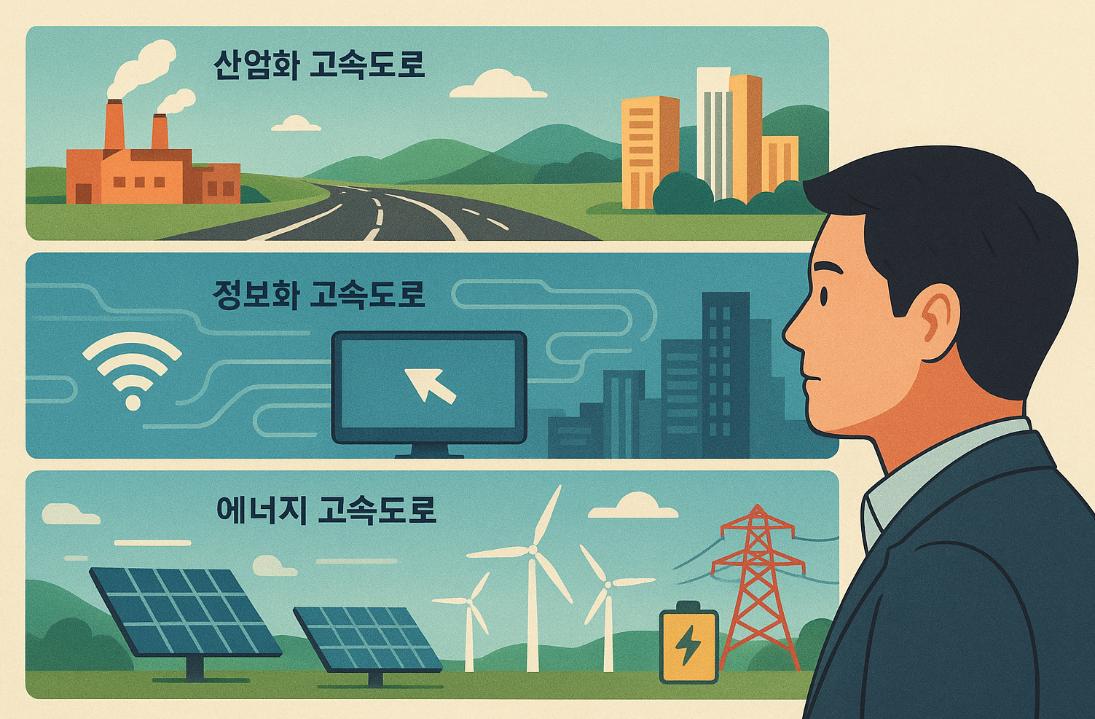
I belong to a generation that has personally witnessed two transformative “highway revolutions” in Korea.
As a child, I saw how a single road could change the fate of entire regions.
As an adult, I experienced how the internet—an invisible network—reshaped industries, daily life, and global competitiveness.
Today, I believe we are standing at the threshold of a third national turning point.
That turning point is the Energy Super Grid.
1. The Industrial Highway: When Roads Built the Economy
There was a time when traveling from regional towns to Seoul was slow and difficult.
Once expressways were built, everything changed.
- Factories followed the roads
- Goods moved faster
- People moved where opportunities emerged
Highways were never just roads.
They became corridors of industry, urban growth, employment, and opportunity.
From steel and automobiles to construction and logistics, Korea’s industrial rise was inseparable from physical connectivity.
That lesson was learned not from theory, but from lived reality.
2. The Information Highway: Invisible Infrastructure, Visible Power
Years later, under the Kim Dae-jung administration, another revolution began—this time without concrete.
Optical cables replaced asphalt.
With nationwide high-speed internet:
- Information became a competitive advantage
- Startups and tech ventures exploded
- The world moved within a single click
This was when I realized something critical:
Invisible infrastructure often creates greater value than visible ones.
Korea’s rise as an ICT powerhouse was not accidental.
It was the result of early, decisive investment in digital infrastructure.
3. Why the Energy Super Grid Is Needed Now
Today, I sense a similar structural shift—this time around energy.
Electricity is no longer just a public utility.
It has become a core industrial requirement.
- Without RE100 compliance, exports face barriers
- Energy price instability directly threatens corporate survival
At this point, past experiences overlap clearly in my mind.
Nations that build infrastructure first lead the future.
The Energy Super Grid is not merely about expanding transmission lines.
It represents a new national energy artery, centered on renewable generation, storage, and intelligent distribution.
4. What the Energy Super Grid Solves in Reality
1) RE100 Pressure Felt on the Ground
Global markets increasingly demand renewable-powered supply chains.
Without compliance, partnerships disappear.
2) Structural Limits of an Energy-Importing Nation
Korea imports most of its energy.
Without energy independence, no crisis—economic or geopolitical—can be fully withstood.
3) A Rare Opportunity for Regional Growth
Solar, wind, hydrogen, and energy storage are not metropolitan-only industries.
They offer real growth potential for regional economies.
5. Comparing Three National Highways
| Category | Industrial Highway | Information Highway | Energy Super Grid |
|---|---|---|---|
| Core Function | Physical connectivity | Digital connectivity | Energy flow |
| National Goal | Industrial modernization | Digital transformation | Carbon neutrality & energy security |
| Economic Impact | Manufacturing growth | IT industry expansion | New energy industries & jobs |
| Historical Meaning | Solving basic survival | Global competitiveness | Sustainable national survival |
Seen this way, the Energy Super Grid is not optional—it is the next logical step.
6. Conclusion: Why I Believe the Third Highway Is Inevitable
Both previous highway projects were criticized at their inception as “too early” or “too ambitious.”
History proved otherwise.
Had they not been built, the cost of delay would have been far greater.
The Energy Super Grid follows the same pattern.
Failing to act now means losing future options.
From someone who has lived through these transitions, my conclusion is clear:
Nations shape their future through infrastructure.
And today, Korea’s most urgent infrastructure is the Energy Super Grid.
About the Author