The Writing Revolution: Recording Sound, Designing Civilization
1. When Did Humans Begin to “Store” Thought?
The essence of civilization is not merely in mastering fire or crafting tools, but in the moment humanity learned to externalize memory. True civilization began when humans no longer relied solely on biological memory to preserve knowledge. That moment arrived with the invention of writing.
Before writing, all knowledge survived only through spoken transmission. History lived in voices, rules in memory, and identity in storytelling. Writing changed that forever. It allowed thought to travel across time and space, transforming individual experience into collective knowledge. Civilization could now accumulate, evolve, and endure.
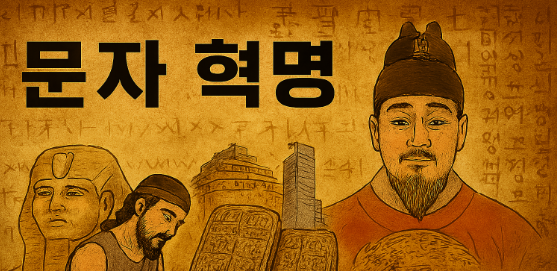
2. The First Writing Systems: Born from Trade, Not Poetry
The origins of writing are not artistic but economic.
Around 3500 BCE in Mesopotamia, one of the earliest known writing systems, cuneiform, emerged not for literature, but for accounting. Clay tablets recorded grain quantities, livestock counts, and transaction logs. Writing began as a tool of management long before it became a medium of expression.
Early writing resembled drawings. A picture of a sheep meant a sheep; a symbol for grain meant grain. But over time, images transformed into abstract signs. Meaning shifted from the visible to the symbolic. This evolution mirrors a deeper human shift—from sensory thinking to structural reasoning.
3. Civilization Carved in Stone and Clay
In the ancient world, writing became the technology of power and permanence.
One of the most famous examples is the Code of Hammurabi. Inscribed on stone and displayed publicly, it transformed law into an enduring structure rather than a matter of memory. Law became technology—and authority became written.
In Egypt, hieroglyphs filled temple walls and tombs, forming an integrated system of religion, governance, and culture. These inscriptions are not merely decorative—they are civilization itself, carved into existence.
4. From Speech to Systems: Writing as the Architecture of Thought
The Chinese writing system marked another turning point.
Originating from oracle bone scripts over 3,000 years ago, Chinese characters represented not only sound, but meaning. This allowed philosophy, governance, and historical documentation to develop with precision unmatched in earlier writing systems.
Writing is not merely a transcription tool. It structures language, disciplines thought, and enables abstraction. Without writing, philosophy cannot mature, law cannot become stable, and science cannot accumulate.
Civilization is, at its core, a written system.
5. Korea’s Writing Revolution: Hangul as a Cognitive Technology
In 1443, world history witnessed something unprecedented.
King Sejong the Great introduced Hangul, the only writing system in the world with:
- a known creator,
- a known creation date, and
- a documented design philosophy.
Hangul is a scientific alphabet. It reflects the shape and function of speech organs, organizing sound logically and systematically. Its result is remarkable: fast learning, flexible construction, and digital efficiency.
In computing environments—keyboards, encoding systems, AI language models—Hangul demonstrates structural advantages that have quietly accelerated Korea’s digital transformation. It is not simply a script; it is a computationally efficient language system.
Hangul is, in many ways, the “semiconductor of language”.
6. From Letters to Data: Writing in the Age of AI
Today, writing no longer lives solely on paper.
We have entered the era of:
- digital writing
- algorithmic language
- machine-readable text
Writing is no longer exclusive to humans. Machines read, analyze, and generate language. Legal documents, academic papers, and creative writing are increasingly interpreted by artificial intelligence.
Humanity’s accumulated writing is now training data.
Code has become a new form of writing.
Data has become a new archive.
The writing revolution did not end with books—it has entered the core of machines.
7. The Writing Revolution Is Not Over
Writing is not a relic of the past.
It continues to evolve.
From drawing to symbols,
from print to pixels,
from text to algorithms,
from memory to machine understanding—
This is not a series of disruptions, but a single expanding curve.
Writing is not how we record civilization.
Writing is how we design civilization.
And the revolution continues.
(Appendix)Evolution of Writing Systems (English Version)
| Era | Writing System | Region | Significance |
|---|---|---|---|
| 3500 BCE | Cuneiform | Mesopotamia | First recording system, trade and administration |
| 3200 BCE | Hieroglyphs | Egypt | Religious and political writing system |
| 1200 BCE | Phoenician Alphabet | Mediterranean | Prototype of modern alphabets |
| 1000 BCE | Hebrew & Aramaic | West Asia | Religious scripture systems |
| 700 BCE | Greek Alphabet | Greece | Introduction of vowels |
| 1st Century | Latin Alphabet | Rome | European writing standard |
| 1200 BCE | Oracle Bone Script | China | Origin of Chinese characters |
| 1443 | Hangul | Korea | Scientific alphabet based on phonetics |
| 15th Century | Printing Technology | Europe | Knowledge dissemination |
| 20th Century | Digital Text | Global | Electronic text and data |
| 21st Century | AI Language Processing | Global | Machine-based understanding and generation |
About the Author